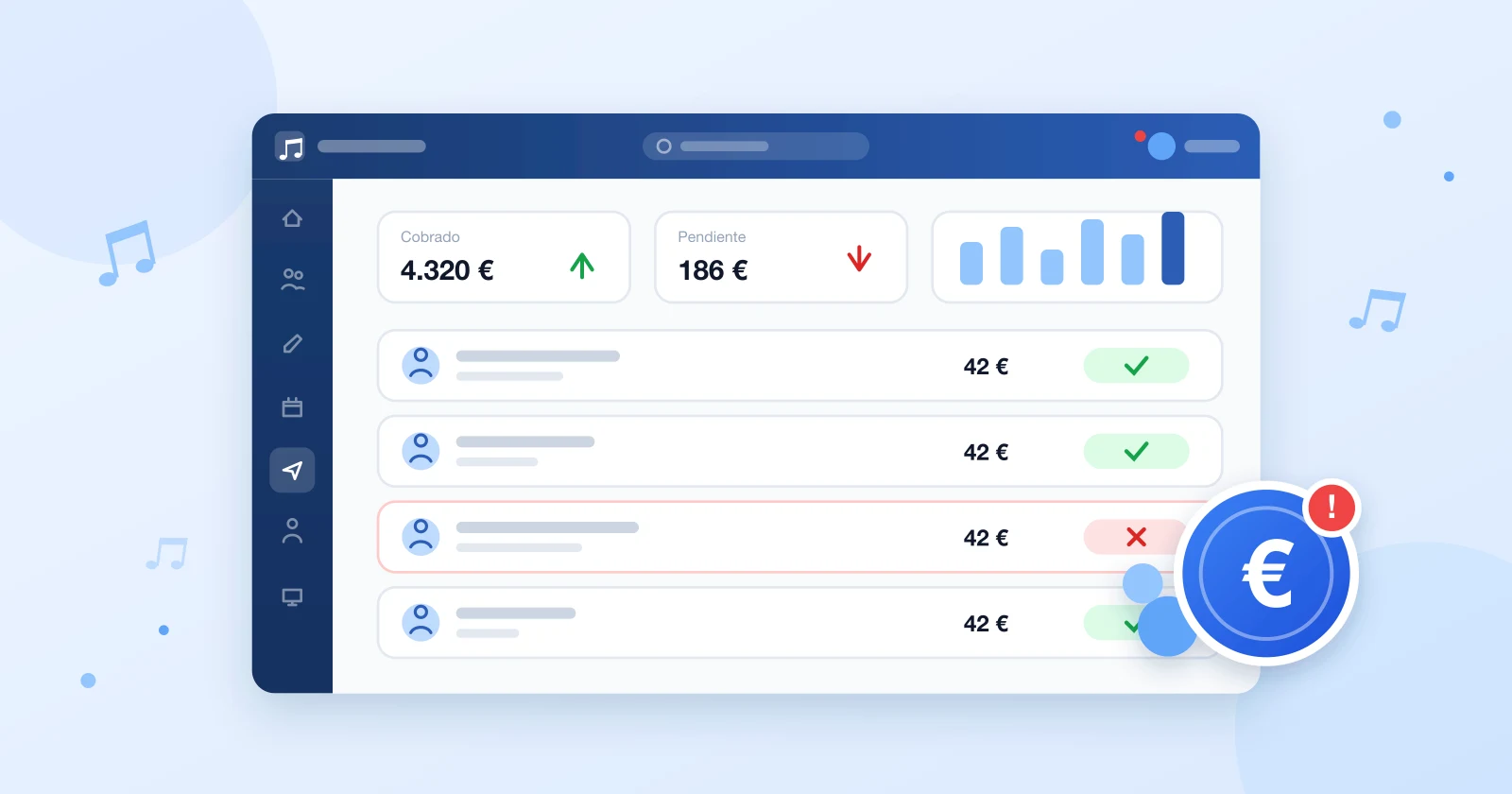
Few things wear down the management of a music academy like chasing unpaid fees: the receipt that bounces, the family that "forgot", the month that gets billed late and is never recovered. Late payments at music academies and schools are rarely about families who do not want to pay — they are almost always the symptom of a fragile collection process. The good news: it is fixed with a system, not with awkwardness. In this guide you will see what every unpaid receipt really costs you, why they happen, and the complete protocol — prevention, direct debit and follow-up — to reduce them to a minimum.
📉 How much do late payments cost you every year?
Work it out for free in 1 minute: enter your students, your average fee and your default rate, and discover the real figure.
The real cost of late payments (it is more than the unpaid fee)
When a 60 € receipt comes back unpaid, the loss is not 60 €. The full cost includes:
- The fee itself — which is often never recovered if more than two months go by.
- The bank's return fee — every bounced receipt carries a fixed cost that the center absorbs.
- Hours of administration — detecting the non-payment, calling, sending reminders, re-invoicing. If your administrator spends two afternoons a month chasing receipts, that salary is a late-payment cost.
- The contagion effect — when families perceive that "nothing happens here if you pay late", the default rate grows on its own.
- The strain on the family relationship — every awkward payment conversation erodes a relationship that sustains next year's enrollment.
Run the numbers with your real figures in our free late-payment calculator: at a center with 200 students, a seemingly harmless default rate easily turns into several thousand euros a year — the equivalent of a teacher's salary for months.
Why late payments happen at a music center
Not all unpaid fees are alike, and each type is fought differently:
1. Forgetfulness (the vast majority)
The family pays by transfer or in cash "when they remember", and some months they do not remember. There is no bad faith: there is a collection method that depends on the customer's memory. It is the most common type of late payment and the easiest to eliminate — it is solved with direct debit.
2. A temporary financial difficulty
A family goes through a tough month and prioritizes other payments. Here the key is to detect it early and offer a solution (deferral, installments) before the debt grows until it becomes unpayable and the family solves the problem by dropping out.
3. Silent dissatisfaction
The student missed two classes, there was a teacher change the family did not like, or they believe December "should not be charged in full". Instead of complaining, they stop paying. It is a communication problem disguised as non-payment: it surfaces late and already entrenched.
4. The structural non-payer (a genuine minority)
They exist, but they are far less common than they seem. If your collection process works, this profile is identified in the second month — not the sixth — and you can apply your policy (suspension of the service) while the debt is still small.
Prevention: the rules that avoid 80% of unpaid fees
Late payments are won or lost at enrollment, months before the first bounced receipt:
- A written, signed payment policy — in the enrollment document: collection date (e.g. the 5th of each month), what happens when a receipt bounces (re-charge + fee), when the service is suspended (e.g. two unpaid fees) and how withdrawals work (notice before the 20th of the previous month).
- Direct debit as the default method — cash and manual transfers should be the justified exception, not just another option on the form.
- Collection on a fixed, immovable date — charging "at the beginning of the month, whenever I can" teaches families that the date is negotiable. Regularity is the first sign of seriousness.
- A prorated annual fee — defining the course as an annual amount divided into equal monthly payments eliminates the recurring "December has fewer classes" argument.
- A clear channel for disagreements — if a family knows exactly who to write to when something does not add up, they complain instead of ceasing to pay.
Amadeus: the digital baton for your music school.
Shall we talk directly?
The fastest way is to talk. Tell us about your school and we’ll show you how Amadeus adapts to your needs. No strings attached.
Direct debit and SEPA batch collections: the big leap
The single change with the biggest impact on late payments is moving from "each family pays however they like" to SEPA direct debit batches: a single file your center sends to the bank that automatically charges the fee to each family's account on the same day.
- SEPA mandate at enrollment — the direct debit authorization is signed once, along with the rest of the enrollment paperwork.
- One single monthly submission — instead of reconciling dozens of loose transfers, you generate one batch with all the month's receipts and upload it to your online banking.
- Unpaid fees are detected in days, not months — returns come back identified per receipt. You know exactly who has not paid without combing through statements by hand.
- Legally compliant invoicing — remember that since Verifactu (Spain's certified invoicing regulation) came into force, your receipts and invoices must be issued from certified software. We cover it in detail in our Verifactu guide for music schools.
Generating these batches by hand (or with the bank's template) is possible, but laborious and prone to formatting errors. A fee collection software built for educational centers generates them on its own from your student list and rates.
Follow-up protocol: what to do when a receipt bounces
When a return arrives anyway, what makes the difference is having a written protocol that is executed the same way every time, regardless of the mood of the day:
| Moment | Action | Tone |
|---|---|---|
| Day 0 (return) | Automatic message reporting the returned receipt and the new charge date. | Neutral: "it was probably a bank error". |
| Day 7 | Second charge of the receipt. If it fails again, a reminder with alternative payment options. | Friendly, offering help. |
| Day 15 | Personal call from management. This is the moment to detect financial difficulty or dissatisfaction and propose a payment plan. | Personal and solution-oriented. |
| Day 30 | Formal written communication citing the policy signed at enrollment and the service suspension date. | Formal, without threats. |
| 2 unpaid fees | Application of the policy: the place is suspended until the debt is settled. Applied always, to everyone equally. | Consistent. |
Two golden rules: the debt must never exceed two monthly fees (beyond that it is almost never recovered and the dropout is guaranteed), and the protocol applies to everyone equally — informal exceptions are the seed of structural late payment.
Automating collection with Amadeus Magister
Everything above can be done by hand — and in fact many centers do, dedicating hours to it every month. The financial module of Amadeus Magister automates the full cycle:
- SEPA batches in one click — the system generates the monthly batch from each student's rates and discounts (siblings, large families, multiple subjects) and produces the file ready for your bank.
- Verifactu-certified invoicing — every fee issues its invoice with a QR code and digital signature, complying with current regulations without additional software.
- Unpaid fees identified automatically — returns are flagged on the specific student, with their complete receipt history.
- Reminders without personal friction — non-payment notices go out through the center's integrated messaging, with the tone you define and without anyone having to make the awkward call during the first steps of the protocol.
- Real-time financial overview — the account balance shows what has been collected, what is pending and how much outstanding debt has accumulated, without opening Excel.
If you want to see the complete circuit working with your real rates, request a free demo: we set up your case during the session and calculate together how much lost revenue you can recover.