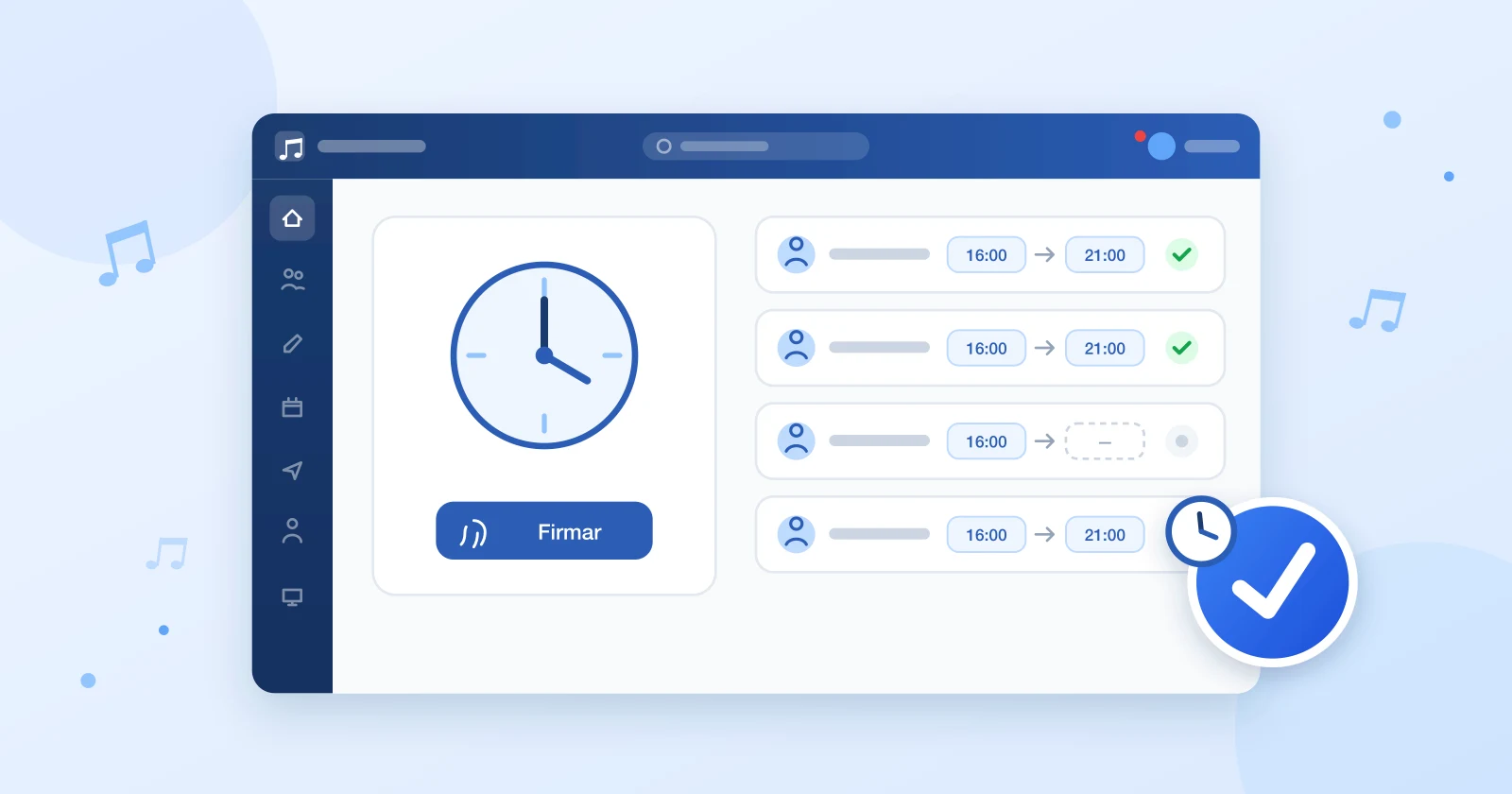
Since 2019, every company in Spain has been required to record its employees’ working hours daily — and music schools, private conservatories and academies are no exception. Yet compliance in the music sector remains patchy: part-time teachers, afternoon schedules split across several centers, and the classic sign-in sheet that someone fills in "when they remember". The problem is that the Inspección de Trabajo (Spanish Labour Inspectorate) does not distinguish between an office and a piano room: it asks for the record, and either it exists and is reliable, or there is a penalty. In this guide we go over exactly what the law requires, how it applies to the real cases of a music center, and how to solve it without paper.
What the law says: working time records have been mandatory since 2019
Spain's Royal Decree-Law 8/2019 added section 9 to article 34 of the Estatuto de los Trabajadores (Spain's Workers' Statute), in force since May 12, 2019. Its essential obligations:
- Daily working time record — it must include the specific start and end times of each worker's day, every day they work.
- For the entire workforce — full-time and part-time. In fact, for part-time contracts (the majority in the sector) the record was already mandatory before 2019, and it is where the Labour Inspectorate looks hardest.
- Retention for 4 years — the records must remain available to workers, their legal representatives and the Labour and Social Security Inspectorate.
- Organization through negotiation — the specific form of the record is set by collective agreement, company agreement or the employer's decision after consulting the workers' representatives.
The rule originates in the ruling of the Court of Justice of the EU in the CCOO v. Deutsche Bank case (May 2019), which requires member states to have "objective, reliable and accessible" recording systems. Those three words matter: as we will see, the paper sheet signed at the end of the month hardly meets that standard.
Does it affect your music school? Specific cases
If your center has at least one employee, the obligation applies to you. Let's look at the sector's typical cases:
Private school or academy with employed teachers
Full obligation: a daily record for every teacher, administrator, and cleaning or front-desk staff member, with real clock-in and clock-out times — not the theoretical ones in the contract.
Part-time teachers working several time blocks
The most common case and the most delicate. A teacher who teaches from 4:00 to 6:30 pm on Mondays and from 5:00 to 9:00 pm on Thursdays needs the record to reflect each real block. In part-time contracts, the absence of a record has an extra consequence: the law presumes the contract is full-time unless proven otherwise, with the back-payment of social security contributions that implies.
Municipal music schools run by a company or association
If management is outsourced to a concession company or an association with employed staff, the obligation falls on that employing entity. The municipal ownership of the service does not exempt anyone from keeping the record.
Activity outside the classroom: recitals, concerts and outings
The Saturday dress rehearsal, the Christmas recital or the end-of-year concert are working time for the teachers involved, and must be recorded just like an ordinary class. It is one of the points that generates the most mismatches between the record and reality.
Who is exempt
- Genuinely self-employed teachers who invoice the center for their classes (beware the "false freelancer": if they have an imposed schedule and use the center's resources, the Labour Inspectorate can reclassify them).
- Partners who are only company directors with no ordinary employment relationship.

Amadeus: the digital baton for your music school.
Shall we talk directly?
The fastest way is to talk. Tell us about your school and we’ll show you how Amadeus adapts to your needs. No strings attached.
What the record must meet to be valid
The rule does not impose a specific system (paper, electronic clock-in or an app are all acceptable), but the criteria of the Labour Inspectorate and the courts do require the system to be:
- Daily and in real time — recorded every day, not reconstructed at the end of the month. Records "filled in all at once" with the same ink and the same handwriting are a classic in infringement reports.
- Objective and reliable — it must reflect the real hours, not copy the contract's theoretical schedule. A record that is identical every day of the year is suspicious in itself.
- Unalterable after the fact — corrections must be traceable. An Excel file anyone can rewrite proves nothing before a labour court.
- Accessible — workers must be able to check their own records, and the company must be able to hand them to the Inspectorate the moment they are requested — visits are unannounced.
- Retained for 4 years — complete and retrievable, even if the worker has left the company.
The record is also the basis for controlling overtime and complementary hours: without it, it is impossible to prove that the part-time teacher does not work them — and that burden of proof works against the center.
Penalties: how much you risk if the Labour Inspectorate knocks on your door
Failing to keep working time records is a serious infringement in labour relations matters (art. 7.5 of the LISOS, Spain's law on labour infringements and penalties), with fines ranging from 751 € to 7,500 € depending on the degree. But the direct fine is usually the small part of the problem:
- Presumption of full-time employment for part-time contracts without a record — with the resulting back-payment of Social Security contributions with retroactive effect, which can multiply the original penalty many times over.
- Individual overtime claims — without a record, the worker's word about their hours gains evidentiary weight over the center's.
- One infringement per affected worker may be found in the most serious cases, and repeat offences raise the degree of the fine.
- The knock-on effect — a visit over working time records rarely ends there: contracts, payslips and risk prevention end up in the same report.
Key fact: working time records have featured among the Labour Inspectorate's planned campaigns since 2019, with special attention to sectors with high part-time rates — exactly the profile of a music school.
The problem with the paper sign-in sheet
The most widespread solution in the sector — the monthly sheet in the staff room — complies with the law only in theory. In practice:
- It is signed at the end of the month, from memory, copying the theoretical schedule: it is neither daily nor reliable.
- It does not record activity outside the center (recitals, concerts, meetings with families).
- It gets lost: four years of paper sheets for the whole faculty are folders nobody can find when the Inspectorate asks for them.
- It leaves no trace of corrections: any crossing-out invalidates its evidentiary value.
- Nobody supervises it: management discovers the gaps when there is no longer any legal way to fill them.
The result is the usual paradox: centers that believe they comply and that, when a visit comes, can prove practically nothing.
Digital time sign-in with Amadeus Magister
Amadeus Magister includes a digital time sign-in module integrated with the rest of the center's management — and that integration is what sets it apart from a generic clock-in system:
- Sign-in from a phone or computer — each teacher signs their clock-in and clock-out in seconds, including at recitals and activities outside the classroom.
- Connected to the center's real schedule — since Amadeus already knows each teacher's schedule, mismatches between what was planned and what was signed are detected automatically.
- Immutable, traceable record — every signature is sealed with a date and time; corrections require approval and leave a trail. Exactly what the "objective, reliable and accessible" standard demands.
- 4 years of automatic custody — the complete history is stored in the cloud and exported in one click if the Inspectorate requests it.
- Worker access to their records — each teacher checks their own history from their account, meeting the accessibility requirement without extra paperwork.
If today your working time record is a sheet pinned to a corkboard, request a free demo and we will show you how to get it sorted — along with schedules, payments and the rest of your management — on a single platform.